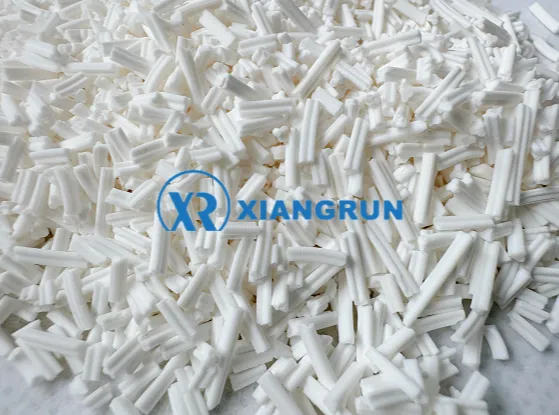
I. Why do alumina catalyst supports pulverize and break?
1. Insufficient Mechanical Strength
Alumina catalyst supports operate under high pressure, high flow rate, and continuous operation for extended periods. If the product itself lacks sufficient compressive strength, it is prone to:
· Particle breakage
· Edge wear
· Surface pulverization
· Bed collapse
Some low-quality alumina supports suffer from:
· Low raw material purity
· Unstable sintering temperature
· Poor internal structure
These significantly reduce mechanical strength, increasing the risk of breakage.
2. Incorrect Filling Method
Many alumina catalyst supports are actually damaged during the filling stage.
Common problems include:
· Direct dumping from height
· Localized concentrated impact
· Uneven filling
· Manual trampling of the bed
These operations can cause latent cracks in the particles, which gradually expand during later operation, eventually leading to pulverization and breakage.
3. Excessive Temperature Fluctuations
Although alumina catalyst supports have good high-temperature resistance, frequent and intense thermal cycling can still damage their internal structure. For example:
* Frequent start-ups and shutdowns of the unit
* Rapid temperature fluctuations
* Localized overheating
These can all lead to increased internal thermal stress in the alumina support, which, after long-term operation, can easily result in:
* Microcracks
* Structural embrittlement
* Particle cracking
Especially in hydrogenation, reforming, and cracking systems, high-temperature fluctuations have a significant impact on support stability.
4. Abnormal airflow impact and pressure drop
If the system experiences:
* Uneven airflow distribution
* Localized high-speed scouring
* Abnormally high pressure drop
This will cause the alumina support to be subjected to continuous and intense impact.
Over time, this can easily lead to:
* Localized wear
* Surface spalling
* Increased dust
In severe cases, it can even lead to bed channeling and collapse.
5. Chemical corrosion leading to structural aging
In certain complex operating conditions, the alumina support may also be subjected to:
* Acidic gases
* Alkaline media
* Water vapor
* Corrosive compounds
Long-term corrosion.
When the pore structure of the support is damaged, its mechanical strength will gradually decrease, leading to an increase in pulverization rate.
II. How to Solve the Problem of Alumina Catalyst Carrier Pulverization?
1. Select a High-Strength Alumina Carrier
The most crucial step in solving the pulverization problem is selecting a high-mechanical-strength alumina catalyst carrier.
High-quality products typically possess:
· Higher compressive strength
· Lower abrasion rate
· More stable pore structure
· Stronger thermal stability
High-quality alumina carriers can significantly reduce the risk of breakage during long-term operation.
2. Optimize the Filling Process
Proper filling can effectively reduce initial damage.
Recommendations:
· Fill slowly in layers
· Avoid dropping from heights
· Use buffer devices
· Control the filling speed
Simultaneously, avoid manually stepping on the catalyst bed.
3. Control System Temperature Fluctuations
For high-temperature reaction systems, avoid as much as possible:
· Rapid heating
· Rapid cooling and heating
· Frequent shutdowns
Stable operation can effectively extend the service life of the alumina carrier.
4. Improved Airflow Distribution
By optimizing:
· Distributor design
· Bed structure
· Support layer configuration
This reduces localized high-speed erosion and lowers carrier wear.
III. Zibo Xiangrun Alumina Carrier Solutions
Addressing common pulverization and breakage problems in industrial plants, Zibo Xiangrun continuously optimizes its alumina catalyst carrier production process through:
· High-purity alumina raw materials
· Stable sintering process
· Enhanced pore structure design
· Increased mechanical strength
This helps customers reduce:
· Pulverization rate
· Wear rate
· Pressure drop
· Catalyst loss
Our alumina catalyst carriers are widely used in:
· Petrochemicals
· Natural gas purification
· PSA hydrogen production
· Environmental catalysis
· VOCs treatment
· Hydrogenation reaction systems
We support customization of various specifications, pore structures, and molding methods.
If you have any questions or needs regarding alumina carriers, please contact Zibo Xiangrun Environmental Engineering Co., Ltd. – a professional alumina manufacturer.