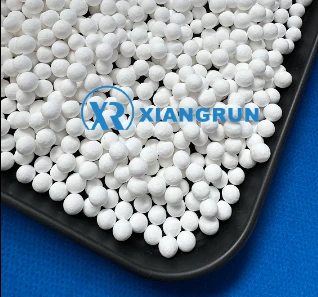
How Activated Alumina Particle Size Affects Adsorption Efficiency
Under otherwise similar conditions, smaller activated alumina particles generally have shorter internal mass transfer distances. Water molecules can enter the adsorption pores inside the particles more quickly, which helps improve the mass transfer rate during the adsorption process. At the same time, smaller particles generally provide a larger external surface area per unit volume of the packed bed, increasing the contact opportunities between the gas and the particles.
Although larger activated alumina particles do not necessarily have lower internal adsorption capacity per unit mass than smaller particles, the mass transfer distance for water to enter the particle interior is relatively longer. Under certain operating conditions involving high flow rates or short contact times, the adsorption capacity inside the particles may not be fully utilized.
How Activated Alumina Particle Size Affects Equipment Pressure Drop
Smaller activated alumina particles usually have narrower gaps between particles, resulting in relatively greater resistance when gas passes through the bed. Under the same conditions, such as bed height and gas flow rate, using particles that are too small may increase equipment pressure drop, thereby increasing the operating load on compressors or blowers.
Larger activated alumina particles generally form relatively larger channels between particles, allowing gas to pass through the bed more easily and reducing gas flow resistance. However, if the particles are too large, the contact efficiency between the gas and the adsorbent may be affected, especially when the equipment has limited contact time.
Which Industrial Equipment Is Suitable for Different Activated Alumina Particle Sizes?
In double-tower compressed air dryers, activated alumina generally needs to achieve a balance between adsorption efficiency, bed pressure drop, and mechanical stability. Particle size should be selected according to the tower diameter, gas flow rate, operating pressure, and regeneration method.
In air separation units, activated alumina is mainly used for air pretreatment and moisture removal. Since air separation units have relatively high requirements for operational stability, gas flow distribution, and bed pressure drop, activated alumina with uniform particle size, high mechanical strength, and low dust content is generally required.
In natural gas dehydration systems, the particle size of activated alumina should be determined according to the gas processing capacity, operating pressure, gas composition, and dehydration requirements. An appropriate particle size helps maintain stable gas flow and improve the utilization efficiency of the adsorption bed.
In PSA oxygen and nitrogen generation equipment, activated alumina is generally used for moisture pretreatment to reduce the impact of moisture on subsequent adsorbent materials. Particle specifications should be determined according to the equipment structure and gas flow conditions, while attention should also be paid to particle strength and dust generation during long-term operation.
Zibo Xiangrun Environmental Engineering Co., Ltd. is a professional alumina manufacturer with more than ten years of production experience. Its products are widely used in industrial gas drying, natural gas dehydration, air separation units, PSA oxygen and nitrogen generation, and petrochemical industries.
To meet the operating requirements of different industrial drying equipment, Zibo Xiangrun can provide activated alumina products in various specifications, including 3–5 mm, 4–6 mm, 5–7 mm, as well as other customized particle sizes. The products focus on particle size uniformity, mechanical strength, adsorption performance, and low dust generation. Corresponding product selection recommendations can be provided according to customers' equipment structures and specific application requirements.