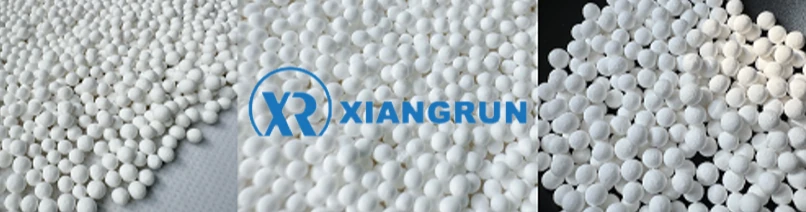
Why Does Saturated Activated Alumina Need to Be Treated?
Activated alumina has a well-developed pore structure and a large specific surface area, enabling it to effectively adsorb moisture from gases.
In compressed air dryers, natural gas dehydration units, and industrial gas purification equipment, activated alumina is commonly used to reduce the moisture content of gases through adsorption, meeting the dew point and drying requirements of downstream processes.
As operating time increases, activated alumina gradually adsorbs moisture, reducing the available adsorption space within its pores. Its remaining adsorption capacity also decreases. If regeneration or replacement is not carried out in time, the moisture content of outlet gas may increase, the pressure dew point may fail to meet requirements, and the stable operation of downstream equipment and production processes may even be affected.
When Can Activated Alumina Be Regenerated?
If the main issue with activated alumina is that it has reached moisture adsorption saturation, while the particles themselves still maintain good integrity, mechanical strength, and pore structure, thermal regeneration can generally be considered to restore its adsorption capacity.
The regeneration process mainly uses heat to desorb the moisture that has already been adsorbed by activated alumina, thereby releasing part of its available adsorption space. After proper regeneration, activated alumina can be put back into service.
For compressed air dryers with a twin-tower configuration, activated alumina typically performs drying operations in one adsorption tower while the other tower undergoes regeneration. The two towers operate alternately to ensure a continuous gas supply. Depending on the dryer design, regeneration methods can be divided into heatless regeneration, micro-heated regeneration, and heated regeneration.
It is important to note that regeneration temperature, heating time, regeneration gas flow rate, and the cooling process all affect the final regeneration results. An excessively low temperature may result in incomplete moisture desorption, while an excessively high temperature or uneven heating may affect the pore structure and long-term performance of activated alumina. Therefore, regeneration operations should follow the technical requirements provided by the equipment manufacturer and adsorbent supplier.
When Should Activated Alumina Be Replaced with New Material?
Not all saturated activated alumina is suitable for regeneration. If the material has already experienced obvious physical damage or performance deterioration during long-term operation, further regeneration may not achieve the expected drying results.
For example, when activated alumina particles show extensive breakage, pulverization, or abrasion, their mechanical strength may no longer meet equipment operating requirements. Particle breakage not only increases dust in the system but may also cause filter blockage, increased bed resistance, and uneven gas flow.
If activated alumina has been seriously contaminated by oil, liquid water, or other contaminants, its regeneration feasibility also needs to be carefully evaluated. Certain contaminants may block the pores or alter the surface properties of the material, and ordinary thermal regeneration may not effectively remove them.
Choosing a Reliable and Stable Activated Alumina Supplier
Zibo Xiangrun Environmental Engineering Co., Ltd. is a professional alumina manufacturer with more than ten years of production experience, mainly supplying activated alumina, alumina powder, pseudo-boehmite, and alumina catalyst supports.
To meet different industrial gas drying and purification requirements, Zibo Xiangrun provides activated alumina products in various specifications and offers customization support for particle sizes and technical parameters according to customers' equipment conditions and actual application requirements.
Whether used in compressed air drying, natural gas dehydration, PSA oxygen generation, or air separation systems, selecting the right activated alumina helps improve equipment operating stability and reduce unnecessary maintenance and replacement costs.