Confirm the Dryer Type:
Before selecting new activated alumina, first confirm which regeneration method the dryer uses. Common adsorption dryers include heatless regenerative dryers, heated regenerative dryers, and other types of regenerative drying equipment.
Different regeneration methods have different working conditions for adsorbents. For example, heatless regenerative dryers usually use part of the dried gas for regeneration, which places relatively high requirements on the adsorption performance, mechanical strength, and cycle stability of the adsorbent. Heated regenerative equipment uses a heating method for regeneration. During actual operation, suitable activated alumina should be selected according to the regeneration temperature, gas flow rate, and operating cycle.
Select the Particle Size:
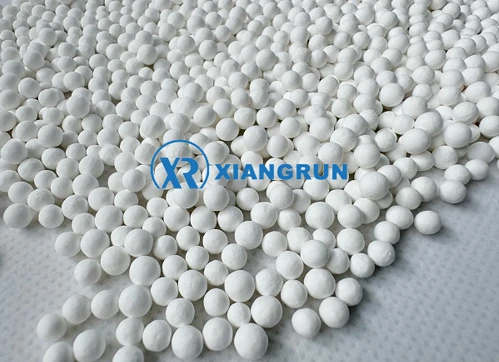
Smaller particles usually have shorter mass transfer paths, which under certain conditions is beneficial for contact between water and the adsorbent. However, if the particles are too small, they may also increase airflow resistance and generate more dust during long-term operation and airflow impact. Therefore, activated alumina for dryers needs to achieve a reasonable balance between adsorption performance and airflow resistance.
Common activated alumina specifications used in industrial drying equipment currently include 3–5 mm, 4–6 mm, and 5–7 mm. When making the actual selection, the particle size used in the original equipment, the adsorption tower design, and the manufacturer's recommended parameters should be considered. If the equipment originally used 4–6 mm activated alumina, the same specification or a technically validated specification should normally be considered as the priority when replacing it.
Consider Mechanical Strength:
If the mechanical strength of the particles is insufficient, they may break and wear during long-term operation. The resulting fine powder may move with the airflow, which may cause downstream dust problems on the one hand, and may also cause changes in the void structure of the adsorption bed, thereby increasing the pressure drop.
Therefore, when replacing activated alumina, it is not sufficient to look only at the Al₂O₃ content or adsorption capacity. The compressive strength, abrasion performance, and dust control capability of the particles should also be considered.
Do Not Ignore the Original Filling Specifications:
If there is a significant difference between the bulk density of the new product and that of the original product, the actual filling weight may change even if the volumetric filling amount remains unchanged. At the same time, after the particle size and particle size distribution change, the void fraction of the bed may also be affected, thereby further affecting gas flow and pressure drop.
Activated Alumina for Dryers from Zibo Xiangrun
Zibo Xiangrun Environmental Engineering Co., Ltd. is a professional alumina manufacturer with more than 10 years of production experience, and its products are exported globally. For industrial drying equipment and gas drying applications, Zibo Xiangrun can provide activated alumina products suitable for different operating conditions.
In terms of product specifications, common particle sizes such as 3–5 mm, 4–6 mm, and 5–7 mm can be provided according to customer equipment requirements. Product selection can also be made based on the customer's equipment type, operating pressure, dew point requirements, and regeneration conditions.
Zibo Xiangrun pays more attention to the overall performance of activated alumina in actual equipment rather than just a single parameter. Stable mechanical strength can help reduce breakage and powdering during operation, appropriate particle size can achieve a better balance between adsorption performance and airflow resistance, and stable adsorption performance helps the dryer maintain continuous water removal capability.