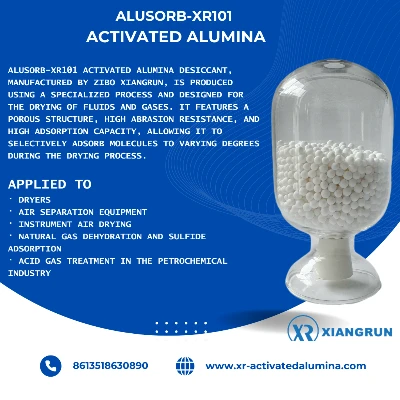
The core function of activated alumina is to adsorb water vapor.
When wet compressed air enters an adsorption tower filled with activated alumina, water molecules come into contact with the surface of the activated alumina particles and are adsorbed by its porous structure and surface active sites. As the wet air continuously passes through the adsorption bed, water vapor gradually transfers from the gas phase to the surface of the solid adsorbent, thereby reducing the water vapor content in the outlet air.
When the water vapor content in the outlet air decreases to a sufficiently low level, its pressure dew point also decreases accordingly.
In a twin-tower adsorption dryer, one adsorption tower is responsible for drying the wet air, while the other adsorption tower undergoes regeneration at the same time. After regeneration is completed, the two towers switch operation, thereby continuously providing dry air.
Why Does Activated Alumina Affect the Dew Point?
In practical applications, the mechanical strength, specific surface area, pore volume, pore size distribution, and surface properties of activated alumina all affect the adsorption and mass transfer of water vapor. If only a very high specific surface area is pursued while particle strength, pore structure stability, regeneration performance, and dynamic adsorption capacity under actual operating conditions are neglected, the desired dew point performance may not necessarily be achieved after the activated alumina is loaded into the dryer.
For industrial dryers, more importantly, it is necessary to determine whether activated alumina can maintain stable adsorption capacity during actual adsorption-regeneration cycles. Recent studies on compressed air adsorption drying have also pointed out that the actual pressure dew point of the product is not only related to the equilibrium adsorption capacity of the adsorbent, but is also affected by dynamic bed utilization, mass transfer zone, regeneration conditions, pressure drop, and cycle stability.
Does the Particle Size of Activated Alumina Affect the Final Dew Point?
Yes.
Smaller particles generally have shorter moisture mass transfer paths and can increase the rate of moisture transfer under certain operating conditions, but particles that are too small may increase bed pressure drop and may also increase the risk of dust and wear. Larger particles generally have lower pressure drop, but the distance for moisture to diffuse into the particles increases, which may affect dynamic adsorption performance under certain operating conditions.
Therefore, activated alumina for dryers needs to be selected with an appropriate particle size according to the equipment airflow, pressure, adsorption time, tower diameter, and target dew point.
Relevant experimental studies have also shown that activated alumina with different particle sizes does not perform exactly the same during the adsorption and regeneration stages. For example, a study on 4–5 mm and 5.5–6.5 mm activated alumina found that, under specific experimental conditions, the two particle sizes differed in adsorption rate, adsorption stability, and regeneration performance.
How Low a Dew Point Can Activated Alumina Achieve?
In conventional compressed air drying applications, activated alumina is commonly used to achieve a pressure dew point of approximately −40°C. The actual dew point that can be achieved depends on multiple factors, including dryer design, inlet conditions, adsorbent performance, regeneration conditions, and operating cycle. Some industrial equipment uses activated alumina as the main adsorbent, while for more stringent ultra-low dew point requirements, a combination of activated alumina and molecular sieve may be used for deep drying.
For example, in systems where further reduction of residual moisture is required, activated alumina can handle a relatively large moisture load, while molecular sieve can be used as the downstream deep-drying medium. This combination is not because activated alumina "cannot dry," but because different adsorbents have different adsorption characteristics under different water vapor partial pressure conditions.
Activated Alumina for Dryers from Zibo Xiangrun
Zibo Xiangrun Environmental Engineering Co., Ltd. is a professional alumina manufacturer with more than 10 years of production experience and exports worldwide. For compressed air dryers and industrial gas drying applications, Zibo Xiangrun can provide activated alumina products suitable for adsorption drying systems.
Zibo Xiangrun's activated alumina for dryers focuses on balancing adsorption performance and particle stability. Through appropriate pore structure and particle properties, it helps the adsorption bed continuously remove water vapor from compressed air. At the same time, the products can provide corresponding particle size specifications according to the operating conditions of different equipment to meet the requirements of different adsorption towers, processing airflow, and pressure conditions.