The Quality of Activated Alumina Itself:
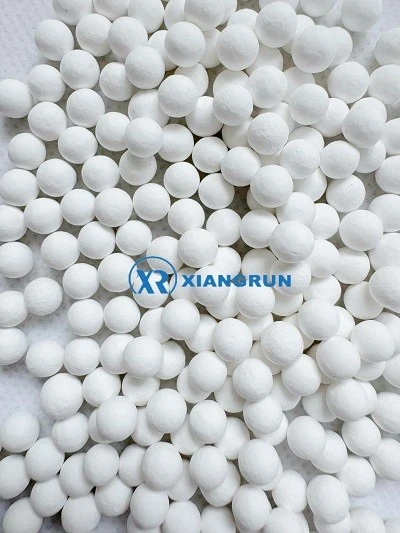
Activated alumina used in air separation units needs to maintain good particle integrity during long-term airflow flushing and periodic regeneration. If the mechanical strength of the particles is low, they are prone to breakage during loading and operation, forming more and more fine powder. These dust particles not only affect the stability of the adsorption bed, but may also cause changes in bed pressure drop. As dust continues to accumulate, the resistance of gas passing through the bed may increase, thereby affecting the operating efficiency of the equipment.
Moisture in the Feed Air:
Activated alumina mainly performs the task of moisture adsorption in the air pre-purification system of air separation units. When the moisture content of the air entering the adsorption tower increases, the amount of moisture that needs to be treated per unit of time also increases. If the actual moisture load remains higher than the equipment design conditions for a long time, the working capacity of activated alumina may reach saturation more quickly, and the adsorption cycle may also become shorter. Especially when the ambient humidity is high or the front-end air treatment conditions change, more attention needs to be paid to the actual moisture load entering the adsorption bed.
Regeneration Conditions:
The adsorbent in air separation units usually needs to undergo periodic regeneration to remove the adsorbed moisture and restore its adsorption capacity. If the regeneration temperature, regeneration time, regeneration gas flow rate, or regeneration gas conditions cannot meet the equipment design requirements, insufficient regeneration may occur. The moisture remaining in the pores of the activated alumina cannot be completely removed, and after multiple cycles, the effective working capacity of the adsorbent may gradually decrease.
Particle Size:
Activated alumina with different particle sizes differs in gas flow resistance, mass transfer efficiency, bed stability, and mechanical wear. Particles that are too small may increase bed pressure drop and are more likely to generate dust under airflow; particles that are too large may affect mass transfer efficiency and the effective utilization of the adsorption bed. Therefore, activated alumina for air separation units is not necessarily better when the particle size is larger, nor is it necessarily better when the particle size is smaller. It needs to be selected according to the structure of the adsorption tower, gas flow rate, operating pressure, and equipment design requirements.
ALUSORB-XR101 Activated Alumina:
For customers who are selecting activated alumina for air separation units, it is recommended not to compare only product prices and a single parameter, but to comprehensively consider mechanical strength, adsorption performance, particle size, abrasion, product stability, and the degree of matching with equipment operating conditions.
Zibo Xiangrun Environmental Engineering Co., Ltd. is a professional alumina manufacturer with more than 10 years of production experience and exports products worldwide. For front-end purification applications in air separation units, Zibo Xiangrun provides specialized activated alumina products and can provide suitable product specifications according to different equipment and operating conditions. The commonly used particle sizes currently include 3–5 mm, 4–6 mm, and 5–7 mm, and product specifications can be matched according to customers' actual application requirements.
Zibo Xiangrun activated alumina for air separation units focuses on particle strength, adsorption performance, particle size stability, and long-term operating performance. In terms of reducing dust, maintaining bed stability, and meeting the moisture adsorption requirements of air separation units, it provides customers with a stable product choice.