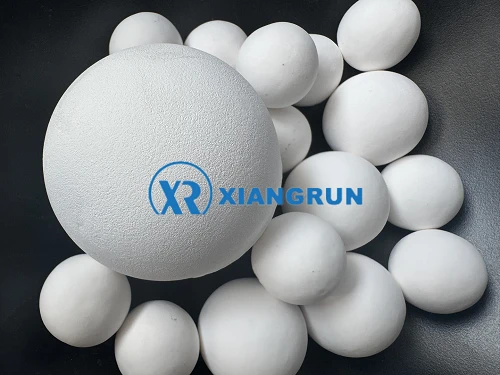
1. Excellent High-Temperature Resistance
Alumina is an inorganic ceramic material with a high melting point and excellent thermal stability. Through proper formulation design and high-temperature sintering processes, alumina ceramic balls can form a dense and stable ceramic structure while maintaining good mechanical properties at elevated temperatures.
In petroleum refining, fertilizer production, gas processing, and high-temperature reaction equipment, filling materials often need to withstand continuous or periodic temperature changes. If the heat resistance of the material is insufficient, long-term operation may lead to structural damage, reduced strength, or material deformation.
Alumina ceramic balls offer good high-temperature stability and can maintain their shape and structure within suitable temperature ranges. Unlike some organic filling materials, they are not prone to softening or thermal decomposition. This makes them suitable for high-temperature reactors, industrial furnaces, and other equipment requiring ceramic filling materials.
2. Excellent Chemical Stability
Alumina ceramic balls offer good chemical stability and can remain relatively stable in many common industrial media without undergoing significant chemical reactions. This is one of the important reasons why they are widely used in petrochemical, natural gas processing, and fertilizer production facilities.
Compared with some metal filling materials, alumina ceramic materials do not undergo common electrochemical corrosion, helping avoid rusting problems that may occur with certain metal materials in specific environments. Meanwhile, their stable inorganic material structure also helps reduce the risk of contamination of process media by filling materials.
However, alumina ceramic balls are not completely inert to all corrosive media. Special operating conditions involving strong acids, strong alkalis, and fluoride-containing media may cause erosion of alumina.
3. High Mechanical Strength
Alumina ceramic balls form a relatively dense ceramic structure through high-temperature sintering and feature high hardness and compressive strength. They can withstand certain mechanical loads and material impacts during operation. In catalyst support beds, reactor filling beds, and other industrial equipment, alumina ceramic balls can provide stable support for internal materials, reducing dust and fine particles generated by damage to filling materials.
4. Excellent Wear Resistance
During the operation of industrial equipment, filling materials may be affected by gas or liquid flow, particle collisions, and long-term friction. If the material surface wears easily, it will not only shorten its service life but may also generate fine powder, affecting the flow conditions inside the equipment.
Alumina ceramic balls have high material hardness and excellent wear resistance. Under suitable operating conditions, they can effectively resist long-term friction and particle impact. Particularly in catalyst support, guard bed, and industrial filling applications, a lower wear rate helps maintain the stability of the packed bed structure and reduce the generation of fine powder.
Zibo Xiangrun Environmental Engineering Co., Ltd. specializes in the production and supply of alumina series products, providing alumina ceramic balls for the petrochemical, fertilizer, natural gas processing, and other industrial sectors.
The company's CBSP-XR3015 alumina ceramic balls are available with 92%, 95%, and 99% alumina content. Corresponding product specifications can be provided according to the requirements of different industrial projects. The products feature good mechanical strength, wear resistance, and chemical stability, making them suitable for filling, support, and related applications in various industrial equipment.