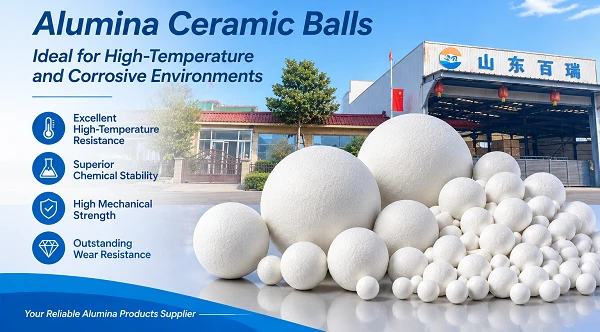
Different Sizes of Alumina Ceramic Balls Have Different Application Characteristics
The particle size of alumina ceramic balls is one of the important parameters to consider when selecting materials for industrial equipment. Generally, smaller ceramic balls provide a greater number of particles per unit volume, creating a relatively denser packing structure, while larger ceramic balls have greater individual particle dimensions, which can help reduce flow resistance between particles in certain equipment and meet the filling requirements of larger spaces.
For equipment requiring fine packing, smaller alumina ceramic balls can help achieve a more uniform particle distribution. For large industrial reactors, support beds, and other applications that need to withstand substantial equipment loads, larger alumina ceramic balls are often better suited to equipment design requirements.
What Industrial Equipment Are Small-Size Alumina Ceramic Balls Suitable For?
Small-size alumina ceramic balls are generally suitable for industrial equipment with specific requirements for packing uniformity and particle size. For example, in certain catalyst support systems, fine packing layers, and equipment with limited internal space, smaller alumina ceramic balls can meet the corresponding filling requirements.
In some petrochemical equipment, small ceramic balls can be used in specific packing layers or support structures to help achieve uniform particle distribution. However, because the gaps between smaller particles are relatively narrow, special attention should also be paid to bed pressure drop and fluid flow capacity when the equipment handles large volumes of gas or liquid.
Applications of Medium-Size Alumina Ceramic Balls in Industrial Packing Systems
Medium-size alumina ceramic balls are widely used in industrial packing and support systems. They provide a relatively reasonable balance between particle size, packing density, and fluid channels. Therefore, they are used in certain oil refining and petrochemical units, fertilizer production equipment, natural gas processing systems, and industrial reactors.
In some multilayer packing structures, medium-size ceramic balls can serve as support or transition materials between different packing layers. According to equipment design requirements, properly configuring alumina ceramic balls of different sizes can help improve the structural stability of packing layers and meet equipment requirements for support materials.
Large-Size Alumina Ceramic Balls Are Suitable for Large Industrial Equipment and Support Beds
Larger ceramic balls are generally used in bottom support layers, packing support layers, and other areas of equipment that require specific particle structures. Under appropriate design conditions, large-size ceramic balls can form relatively larger channels between particles, facilitating fluid flow and meeting equipment requirements for support structures.
In addition, in certain high-temperature industrial equipment, large-size high alumina ceramic balls can also be used as high-temperature-resistant ceramic materials. For these applications, customers need to consider not only product size but also select appropriate alumina content and product performance according to operating temperature, mechanical load, and process media conditions.
Zibo Xiangrun Provides Alumina Ceramic Balls in Multiple Specifications
Zibo Xiangrun Environmental Engineering Co., Ltd. is a professional alumina manufacturer with more than 10 years of production experience, providing various alumina products and industrial ceramic materials to customers worldwide.
To meet the application requirements of different industrial equipment, Xiangrun provides ceramic balls with alumina contents of 30%, 45%, 92%, 95%, and 99%, and particle sizes ranging from 0.5 to 95 mm. These products can meet the performance and operating condition requirements of different industrial projects. They can be used in petrochemicals, fertilizer production, industrial catalysis, reactor packing, equipment support, and other industrial fields.