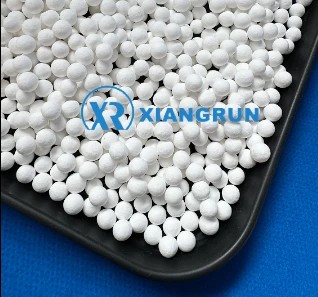
If the regeneration process is not properly controlled, problems such as incomplete moisture removal, reduced adsorption capacity, and particle pulverization may occur. So, what should be considered during activated alumina regeneration?
1. Properly Control the Regeneration Temperature of Activated Alumina
If the regeneration temperature is too low, moisture may not be fully removed, leaving excessive residual moisture in the activated alumina before the next adsorption cycle begins and affecting subsequent drying performance. On the other hand, if the regeneration temperature is too high, it will not only increase energy consumption but may also affect the pore structure, mechanical properties, and long-term stability of the adsorbent.
2. Ensure Sufficient Regeneration Time
If the regeneration time is insufficient, moisture inside some particles may not be fully removed, resulting in incomplete adsorbent regeneration. This is particularly important when the adsorbent loading is large, the inlet gas humidity is high, or the operating load changes, as the original regeneration cycle may no longer be suitable.
3. Ensure the Quality and Flow Rate of Regeneration Gas
If the regeneration gas itself contains excessive moisture, or if it contains oil mist, dust, and other contaminants, it may affect the regeneration performance of the adsorbent and even cause secondary contamination. Therefore, an appropriate regeneration gas source should be selected according to the equipment design requirements, ensuring that the regeneration gas meets the system's cleanliness and humidity requirements.
At the same time, the regeneration gas flow rate must also be properly controlled. An excessively low flow rate may result in insufficient heat transfer and prevent water vapor from being discharged in time. An excessively high flow rate may increase system energy consumption and affect the operating economy of the equipment.
4. Pay Attention to the Cooling Process After Regeneration
Activated alumina reaches a relatively high temperature after heating. If it is put directly into the adsorption stage without being sufficiently cooled according to equipment requirements, it may affect gas drying performance and increase the operating load of the equipment. In addition, if gas with high humidity is introduced during the cooling stage, the freshly regenerated activated alumina may re-adsorb moisture, reducing its effective adsorption capacity.
Therefore, after regeneration is completed, cooling should be carried out according to the equipment design requirements. The temperature and humidity of the cooling gas should be controlled to ensure that the adsorbent reaches a suitable operating temperature before entering the next adsorption cycle.
5. Avoid Contamination from Oil and Other Impurities
During compressed air drying, natural gas dehydration, and petrochemical gas treatment, activated alumina may come into contact with oil mist, dust, liquid water, and other impurities.
Oil contamination deserves particular attention. Oil substances may adhere to the surface of activated alumina particles or enter their pores, affecting the contact between moisture and adsorption sites and reducing effective adsorption performance. For adsorbents that have already been seriously contaminated, conventional thermal regeneration alone may not be sufficient to restore their original performance.
Zibo Xiangrun Environmental Engineering Co., Ltd. is a professional alumina manufacturer with more than 10 years of production experience. Its products are exported to multiple countries and regions. The company provides activated alumina products in various specifications for applications including compressed air drying, air separation units, natural gas dehydration, industrial gas treatment, and petrochemical processing.
Zibo Xiangrun's activated alumina products focus on adsorption performance, particle strength, uniform particle size, and low abrasion loss, meeting the requirements of different industrial drying equipment for adsorbent materials. Corresponding particle sizes and technical specifications can also be customized according to different equipment operating conditions and customer requirements.