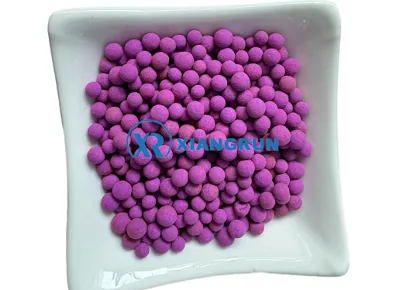
I. Observing Color Changes
Observing color changes is one of the most intuitive methods for determining whether potassium permanganate-impregnated activated alumina requires replacement.
Fresh potassium permanganate-impregnated activated alumina typically appears purplish-red or deep purple; this coloration is due to the potassium permanganate loaded onto its surface. During the process of adsorbing and oxidizing harmful gases, the potassium permanganate continuously participates in chemical reactions and is consumed; consequently, the color gradually shifts from purple to brown, reddish-brown, or even grayish-white.
When the color of the majority of the granules has visibly faded, and the overall color distribution appears uneven, it generally indicates that a significant portion of the active components has been depleted, and replacement should be considered.
Ⅱ. The purification effect is significantly reduced
The decrease in purification efficiency is the most direct failure signal.
If the system is designed to effectively remove the following contaminants:
·Hydrogen sulfide (H₂S)
·Formaldehyde (HCHO)
·Sulfur dioxide (SO₂)
·Ammonia (NH₃)
·Volatile organic compounds (VOC)
And recently discovered:
·Odor reappears
· Emission indicators rise
·Gas concentration exceeds standard
·Increase in customer complaints
Even if the equipment is running normally, it is likely that the potassium permanganate activated alumina is close to saturation and needs to be replaced in time.
III. Significant Increase in Pressure Drop
As operating time increases, airborne dust, particulate matter, and reaction byproducts gradually accumulate within the bed layer.
Common symptoms include:
• Increased fan load
• Increased system energy consumption
• Reduced airflow
• Increased differential pressure
If the pressure drop across the equipment rises significantly above its initial value-even if the adsorbent has not yet completely lost its effectiveness-system operation may still be compromised due to clogging; in such cases, replacement with fresh potassium permanganate-impregnated activated alumina is required.
IV. Severe Granule Pulverization or Fragmentation
High-quality potassium permanganate-impregnated activated alumina possesses high mechanical strength; however, after prolonged operation, the following issues may still occur:
• Pulverization
• Cracking
• Fragmentation
• Surface spalling
Particularly under conditions of high humidity, high airflow velocity, or frequent system start-ups and shut-downs, the rate of granule attrition accelerates significantly.
When the accumulation of fine powder within the packed bed becomes substantial:
• The effective contact surface area decreases.
• Airflow distribution becomes uneven.
• Pressure drop increases.
All of these factors compromise purification efficiency; therefore, the material should be replaced promptly.
How to Extend the Service Life of Potassium Permanganate-Impregnated Activated Alumina?
To enhance adsorption efficiency and reduce operating costs, the following measures can be implemented:
· Install a pre-filter to minimize dust ingress.
· Maintain inlet air humidity within a reasonable range.
· Avoid operating at pollutant concentrations exceeding design specifications.
· Regularly inspect the condition of the adsorbent bed.
· Select products featuring high mechanical strength and high loading capacity.
· Ensure uniform airflow distribution.
These measures effectively extend the service cycle of potassium permanganate-impregnated activated alumina and enhance the overall stability of the air purification system.
Zibo Xiangrun: Potassium Permanganate-Impregnated Activated Alumina Solutions
As a professional manufacturer of activated alumina and air purification materials, Zibo Xiangrun Environmental Engineering Co., Ltd. offers high-performance potassium permanganate-impregnated activated alumina products. Utilizing a high-quality activated alumina carrier, our products feature a high specific surface area, superior mechanical strength, uniform loading, and excellent oxidative adsorption capabilities, enabling the efficient removal of hydrogen sulfide, formaldehyde, sulfur dioxide, ammonia, and various VOC pollutants. Catering to diverse application scenarios-including wastewater treatment plants, waste disposal stations, chemical plants, data centers, and commercial air purification systems-Zibo Xiangrun provides customized product selection and technical support solutions tailored to each client's specific operating conditions, helping users achieve extended service life, reduced operating costs, and more stable purification results.