The size of alumina ceramic balls is not simply a matter of choosing the largest or the smallest option. Different ball sizes are suitable for different types of reactors, catalysts, and operating conditions. Selecting an inappropriate size may not only affect fluid distribution and pressure drop but also reduce catalyst utilization and increase equipment operating costs. Therefore, understanding how to choose the appropriate ball size according to actual operating conditions is essential for ensuring the long-term stable operation of industrial equipment.
Although alumina ceramic balls do not directly participate in catalytic reactions, they play important roles in supporting catalysts, ensuring uniform fluid distribution, protecting the support grid, and reducing localized impact.
If the ball size is too small, it can form a denser support layer, but it also increases flow resistance, resulting in a higher pressure drop and greater energy consumption.
If the ball size is too large, the flow resistance is lower, but the larger voids between the balls may allow catalyst particles to fall through or cause uneven gas and liquid distribution, reducing reaction efficiency.
Therefore, selecting the proper ball size requires a balance between mechanical support capacity, fluid distribution, and system pressure drop.
Selection Based on Catalyst Particle Size
In most catalyst support beds, the size of alumina ceramic balls is matched to the catalyst particle size.
Generally, the diameter of the top support layer should be larger than the catalyst particle size to prevent catalyst particles from falling through the gaps while ensuring good fluid distribution.
For catalysts with smaller particle sizes, smaller alumina ceramic balls are generally used. For larger catalyst particles, larger ceramic balls can be selected.
This gradual transition design improves bed stability and reduces localized stress concentration.
Selection Based on Reactor Size
For large industrial reactors, larger alumina ceramic balls, such as 25 mm, 38 mm, 50 mm, or even larger sizes, are typically used at the bottom of the reactor to support the greater weight of the catalyst bed and provide sufficient mechanical strength.
For small and medium-sized reactors, smaller ceramic balls are generally preferred to achieve more uniform fluid distribution.
Many large reactors adopt a multi-layer arrangement, gradually transitioning from larger balls at the bottom to smaller balls at the top, resulting in a more stable catalyst bed.
Selection Based on Process Medium
Different process media also have different requirements for ceramic ball size.
In gas-phase reactions, where gas flows at relatively high velocities, pressure drop is usually the primary concern. Therefore, larger ceramic balls are often selected to reduce flow resistance.
In liquid-phase or gas-liquid two-phase reactions, more emphasis is placed on uniform fluid distribution. In such cases, appropriately smaller alumina ceramic balls help improve liquid wetting and enhance reaction efficiency.
For operating conditions involving high impact loads or frequent start-up and shutdown cycles, both the mechanical strength and thermal shock resistance of the ceramic balls should also be taken into consideration.
Common Sizes of Alumina Ceramic Balls
Common industrial sizes of alumina ceramic balls include 3 mm, 6 mm, 10 mm, 13 mm, 16 mm, 19 mm, 25 mm, 38 mm, and 50 mm.
Smaller ceramic balls are mainly used in the upper section of the catalyst bed or in fine support layers to improve fluid distribution. Medium-sized balls are widely used in standard catalyst support layers, while larger ceramic balls are mainly installed at the bottom of reactors to provide primary load-bearing support.
In practical engineering applications, a single size is rarely used. Instead, different ball sizes are combined according to the reactor design to achieve an optimal balance between support strength, fluid distribution, and operational stability.
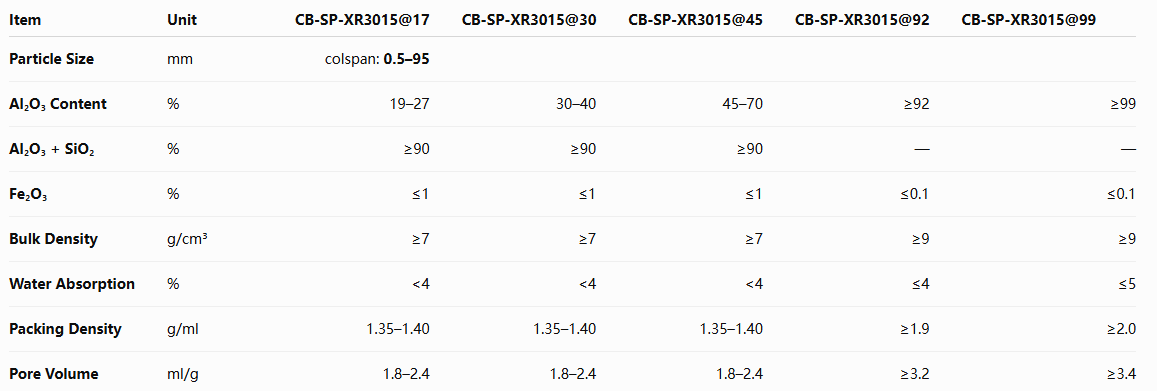
In addition to ball size, other important factors such as alumina content, compressive strength, water absorption, thermal shock resistance, acid and alkali corrosion resistance, and dimensional tolerance should also be considered. High-quality alumina ceramic balls not only feature uniform particle size and excellent mechanical properties but also maintain stable performance under high-temperature, high-pressure, and corrosive operating conditions, effectively protecting catalysts and reducing maintenance costs.
If you are selecting the appropriate alumina ceramic balls for your catalyst support bed, Zibo Xiangrun Environmental Engineering Co., Ltd. can provide professional selection recommendations and customized solutions based on your reactor size, catalyst type, and operating conditions. We offer high-quality alumina ceramic balls in a wide range of sizes (0.5–95 mm) and alumina contents (30%, 45%, 92%, 95%, and 99%). Our products feature high compressive strength, excellent high-temperature resistance, and precise dimensional consistency, making them widely used in petrochemical, natural gas, coal chemical, fertilizer, and environmental protection industries to help customers achieve safer, more efficient, and more stable operations.